
New York Times article: Forecasters Face Loss of Data as Weather Balloon Flights Are Cut, https://nyti.ms/3uVqeIv, published 5 April 2022.
The National Weather Service has cut back on weather balloon launches at some of its sites because of shortages of hydrogen and helium used to lift them, potentially affecting forecasts and weather and climate research.
The cutbacks, coupled with the closing of a launch site on Cape Cod last year that has yet to reopen, could especially affect forecasting in the New York-New England area, some scientists said.
“We can’t go back and get that data,” said Sandra Yuter, a professor at North Carolina State University and an expert on remote sensing of meteorological data. “We’re going to have big gaps.”
Dr. Yuter said the cutbacks showed that the weather service was not placing high enough priority on weather balloons, which have been a staple of the agency’s observations for nearly a century.
Dr. Yuter said that balloon data helps scientists understand the structure of the atmosphere and “feeds into our understanding of what will happen as the climate changes.”
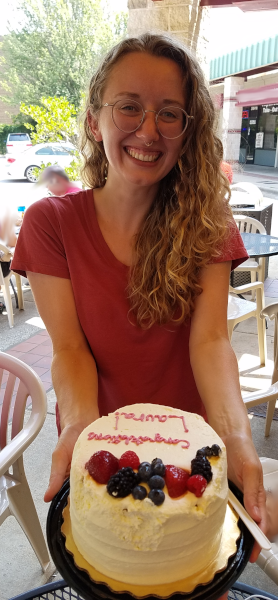 Laura Kent celebrates her successful oral defense on 5 August 2021 of her Master’s thesis “Multi-year Analysis of Ice Streamers Within Coastal Northeast US Winter Storms”.
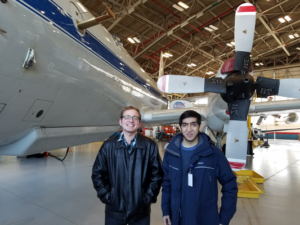 During January and February 2020, group members Matthew Miller, Sandra Yuter, Laura Tomkins, Ronak Patel, and Daniel Hueholt will spend time at NASA Wallops Flight Facility in Virginia supporting mission science and forecasting for the NASA Investigation of Microphysics and Precipitation for Atlantic Coast-Threatening Snowstorms (IMPACTS) field program. Matthew Miller will also go to Hunter Army Airfield in Georgia to work in mission science support for the NASA ER-2 aircraft. Image: Meteorology majors Daniel Hueholt and Ronak Patel standing in front of the P3 research aircraft at NASA Wallops Island Flight Facility. Both students did winter storm forecasting and P3 aircraft data collection for the NASA IMPACTS field program.
 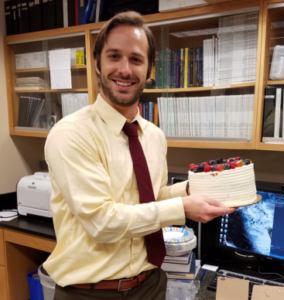 Spencer Rhodes celebrates with cake on 30 October 2019 after his successful oral defense of his Master’s Thesis “Large-scale environments associated with southeast Atlantic marine stratocumulus cloud-eroding boundaries”.
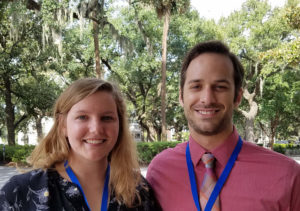 Laura Tomkins and Spencer Rhodes in Savannah, Georgia for the AMS Mesoscale Conference.